The Haitian Revolution and Hispaniola's Slave Revolts
 |
| Oge |
Between 1791-1804, the Haitian Revolution swept through Saint-Domingue. The Oge Rebellion of 1790 is considered to be the start of the revolution. Oge acquired weapons and formed an army of about 300 blacks and mulattoes and marched to Grande-Rivière with the intent of taking control of the city. With his army eventually disbanded, Oge went into hiding in Spanish Santo Domingo.
The Revolution Begins
The Haitian Revolution officially began on August 14, 1791 with the Bois Caiman Ceremony in which the slaves met in Mourne-Rouge for final instructions. It was here that the slaves decided the revolt would be set afoot with the burning of plantations. It was also where two hundred slave leaders from various plantations met and confirmed their plans, as well as preformed a powerful voodoo ceremony. It is important to note that these leaders were all slaves who held prestigious posts on their plantations. Between August 22, 1791 and mid-September of the same year, Haitian slaves launch various revolts which include the burning of the largest plantations in the colony, the capturing and killing of many whites and the building of their forces to about 15,000 revolutionists. Because of the large amount of destruction from the revolt, The National Assembly of France made the decision to revoke the rights they had given to free blacks and mulattoes on September 24 1791. In response to this, many mulattoes joined in the revolt and the rebels take hold of Port-Au-Prince.
Toussaint L'Ouverture
By October 1791, the Port-Au-Prince has been completely burned to the ground and the most famous revolutionary Toussaint L'Ouverture begins to gain popularity. By the end of 1791, the rebels hit a large bump in the road because their leader Boukman is killed in battle and their ammunition and supplies become depleted Also, the beginning of 1792, the Spanish declares war on the French and British and these European powers come to the colony and fight over its valuable land. By June of 1792 the mulatto rebels ally with the British and again take an upper hand in the rebellion. After this alliance, the city of Le Cap is turned into a burning war zone and French colonists, desperate for control issue the right of full French citizenship to any slave who is willing to help defend the colony against any foreign and domestic threats. Also in September of 1792, Louis the XVI is beheaded and the monarchy of France is officially overthrown, creating the French Republic. In February 1793, L'Ouverture officially takes control of the rebel forces and France declares war on both the English and Holland. By the end of the year, with the anniversary of the French Republic and fighting being waged in the colony between slaves, slave owners, and European powers, the French government officially abolishes slavery in the colonies on February 4, 1794. Though it is abolished by the French, the Spanish still has not abolished slavery in Hispaniola and has not withdrawn its forces from that side of the island. L'Ouverture decides to leave the Spanish forces and side with the French in order to work abolish Spanish slavery on the island as well. On July 22, 1795, the French and Spanish sign the Treaty of Basal, establishing peace between the two and the following June, Spanish forces are officially retreated from Hispaniola. Also in 1795, L'Ouverture has established himself as the most powerful leader in Haiti. He leads Haitian forces in a civil war against Rigaud and in 1801, L'Ouverture proclaims himself to be the surpreme commander and chief of Haiti. He draws up a constitution abolishing slavery forever in Haiti and eliminating any color discrimination between blacks, whites and mulattoes in Haiti. Many planters are unhappy with L'Ouverture's decisions and look to Napoleon to over throw him and restore slavery to the colony. Rebels begin another uprising, this time in order to declare Saint-Domingue independent. In October 1801, L'Ouverture captures Moise, the rebel leader and has him tried and then shot, creating further divisions among the rebels and colonists alike. Napoleon sends a large number of French forces to Saint-Domingue, lead by Leclerc in order to rid the island of any powerful black or mulatto leaders, and reinstate the institution of slavery. Leclerc tricks L'Ouverture by saying that he is going to step down his forces and leave Saint-Domingue without reinstating slavery, however he later captures L'Ouverture and restarts the war against the blacks and mulattoes.
Independence and the Establishment of Haiti
With L'Ouverture captured and the French still inciting battles against the blacks and mulattoes of Saint-Domingue, the rebel forces made Jean Jacques Dessalines their new leader against the European forces. The colonial forces are able to hold the French and Napoleon off until they are completely out of money and supplies. Crippled by this, Napoleon sales his United States land holdings to Thomas Jefferson in the Louisiana Purchase Treaty on April 30, 1803. On May 18, 1803, Dessalines creates the Haitian flag by tearing the white stripe from the French flag leaving only the blue and red, signifying the unity of blacks and mulattoes against the whites. The French then begin their retreat from Saint-Domingue in August and the French leader Rochambeau finally surrendered in on November 17. On January 1, 1804 after so many battles, Dessalines officially declares Haiti's independence, removing the French colonial name Saint-Domingue and restoring the original Taino name "Hayti" to the land. Haiti becomes the first black republic and the first independent Caribbean nation and Dessalines is now known as the first emperor of Haiti, Jacques I. He ratifies a constitution making all Haitians considered black, forever abolishing slavery, and allowing all citizens the right to own land. He also orders all remaining French citizens to be killed.
Conclusion
Slavery on the island of Hispaniola proved to be a major factor in the establishment of the country of Haiti. Although slavery is considered to be a negative institution in history it proved otherwise in the creation of Haiti because without the large slave population their would not have been the remarkable story of Haitian independence.
 |
| The burning of large plantations in Le Cap, 1791 |
Toussaint L'Ouverture
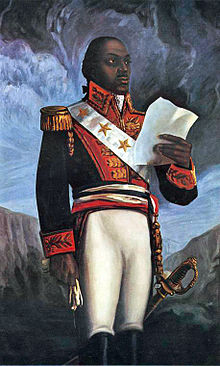 |
| Toussaint L'Overture |
Independence and the Establishment of Haiti
 |
| Dessalines and the Haitian Flag |
Conclusion
Slavery on the island of Hispaniola proved to be a major factor in the establishment of the country of Haiti. Although slavery is considered to be a negative institution in history it proved otherwise in the creation of Haiti because without the large slave population their would not have been the remarkable story of Haitian independence.
Sources
1.)History of Haiti: http://library.brown.edu/haitihistory/10.html) Slavery and the Haitian 2.)Revolution: http://chnm.gmu.edu/revolution/chap8a.html


